
7. Can AI Backtest a Trading Strategy? Claude Tested 288, We Tested the Winner
Claude, connected to NOROVIEW through MCP, tested 288 strategy variants on two months of Ethereum and uploaded the winner: +11.56% on 13 trades. We rebuilt it trade for trade, then ran the same rules on four months it never saw. Lesson 7 of the free Order Flow Crash Course.
7. Can AI Backtest a Trading Strategy? Claude Tested 288, We Tested the Winner
⚠ Education only. Nothing in this article is financial advice. Trading is high risk and you can lose your money. Full disclaimer at the bottom.
Can AI backtest a trading strategy? Mechanically, yes. In this lesson Claude, connected to NOROVIEW through MCP, pulled two months of Ethereum candles and order-flow indicators, wrote its own backtest, tried 288 versions of a strategy with fees, and uploaded the best one: 13 trades, +11.56%, a profit factor of 4.14. We rebuilt that backtest from the same data and matched all 13 trades to within a cent. What a backtest cannot do is tell you whether the winner will keep winning, so we ran the same rules, unchanged, on four months Claude never saw.
This is lesson 7 of the free NOROVIEW Order Flow Crash Course, built from an eight-minute video. The account is free, but the AI connection is not: MCP access starts on the Basic plan, and this lesson's strategy needs Pro. Create a free NOROVIEW account to follow along, and read the plan details below before anything costs money.
What you'll learn in this lesson
- How to connect Claude to NOROVIEW with MCP, and which plan it needs
- What the connection lets Claude do, and what it cannot touch
- The six rules Claude uploaded, including two the video skips
- The arithmetic behind +11.56%, a profit factor of 4.14 and a 1.06% drawdown
- Why the best of 288 variants flatters the winner
- What happened when we ran the same rules on four months Claude never saw
Lesson 7 of the Order Flow Crash Course. New here? Lesson 1 covers what a candle hides and lesson 5 volume profile shapes; lessons 3 and 6, both live trades, are on video only. The written course covers the position sizing used here.
Prefer to watch it?
I Connected Claude AI to Order Flow Data. It Built This Strategy is the lesson this article is built from - eight minutes, on a live account. Everything else: the full crash course playlist · the NOROVIEW channel.
The words you need before we start
| Term | What it means |
|---|---|
| MCP | Model Context Protocol: an open standard that lets an AI assistant use another app's tools |
| Backtest | Rules replayed on past data to see what they would have done. Hypothetical by definition |
| In sample / out of sample | The data a strategy was built and chosen on / data it never saw |
| R | The amount risked on one trade. Here 1R is 1% of the account |
| Profit factor | Gross profit divided by gross loss |
| NORO Signal | NOROVIEW's buy and sell arrows on candles whose order flow stands out |
| Unfinished Auction | A candle's high or low that traded on both sides, often revisited later |
Can AI backtest a trading strategy? What Claude actually did
It did not guess. Claude first checked what each indicator returns, then pulled 1,488 hourly candles of Kraken's ETH perpetual for 31 August to 31 October 2026, with 17 NORO Signal arrows and 337 Unfinished Auctions, through NOROVIEW's connector. It wrote the backtest in Python, ran it locally, tried 288 variants with Kraken's 0.05% taker fee on both sides of every trade, and uploaded the best one to David's NOROVIEW account, where each trade can be replayed on the chart.
The mechanics held up: rebuilt from the same data, all 13 trades match on entry, stop, target and exit. What no backtest can tell you is whether the winner of a search will keep winning. That needs data the search never saw, and it is the second half of this article.
What it takes: one connector, and a paid plan
MCP is an open standard for connecting AI assistants to other software. NOROVIEW runs an MCP server, and the MCP button on the chart's right-hand toolbar opens a panel with the address to give Claude.
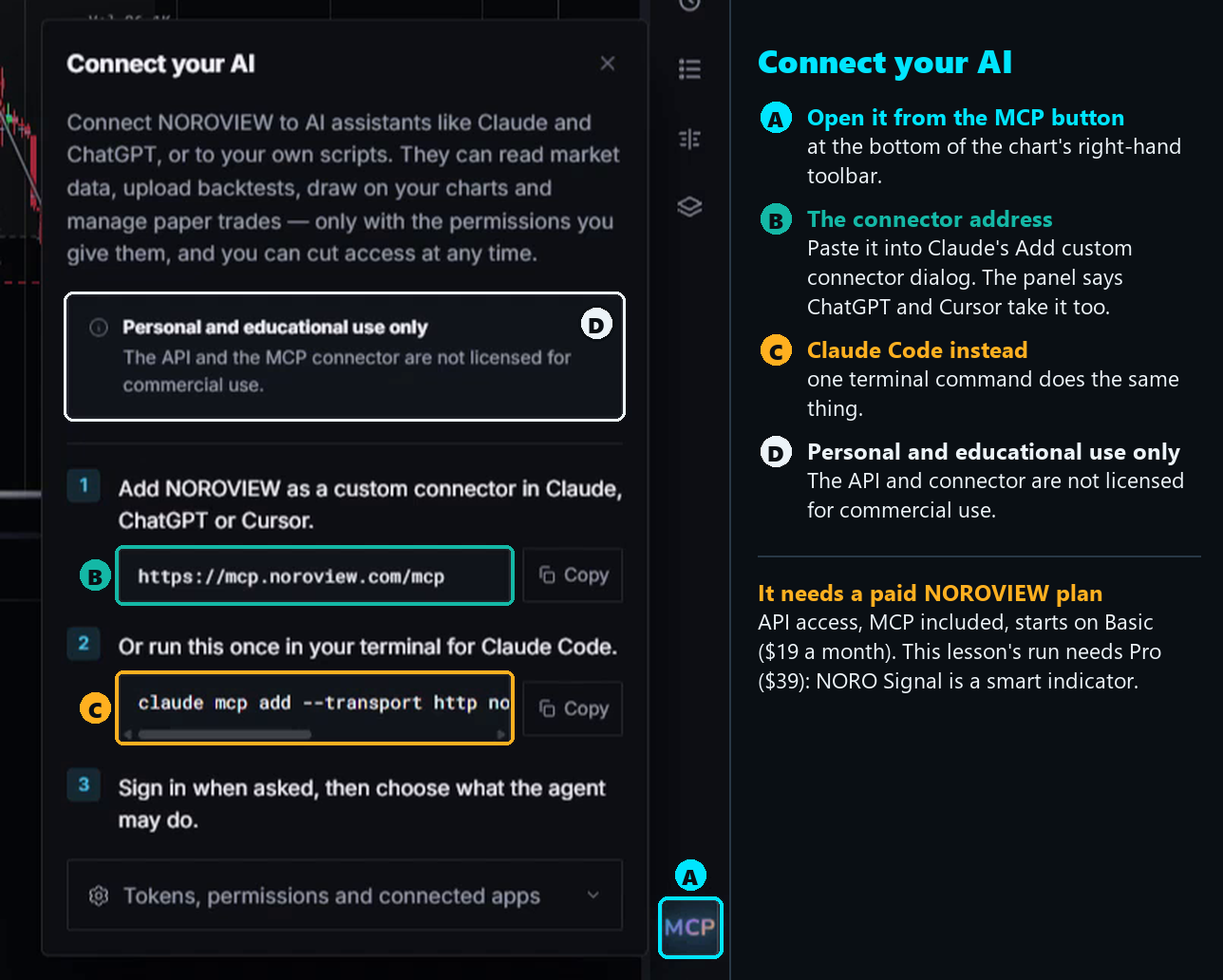
The video says to sign up for free, and the account is free. The connection is not. NOROVIEW's plans list API and AI-agent access - the REST API, the live feed and the MCP server - from Basic ($19 a month) up; on Free, the consent screen cannot be approved. And this strategy needs more than Basic:
- NORO Signal is a smart indicator. Basic allows none through the API, Pro ($39) allows five. On Basic, Claude's request for the arrows would come back "not available".
- Unfinished Auction and Key Levels are advanced indicators: two on Basic, ten on Pro.
- Basic stores two backtests and allows 5 API requests a minute. The 288 variants ran in local code and cost no requests; pulling the data takes a few dozen, which is minutes of waiting at that rate, not a blocker.
Connecting Claude, step by step
- In NOROVIEW, open the MCP panel and copy the address,
https://mcp.noroview.com/mcp. - In Claude Desktop, open Connectors - from the + button in a chat, or Customize → Connectors - and click Add, then Add custom connector. Name it, paste the address and click Add.
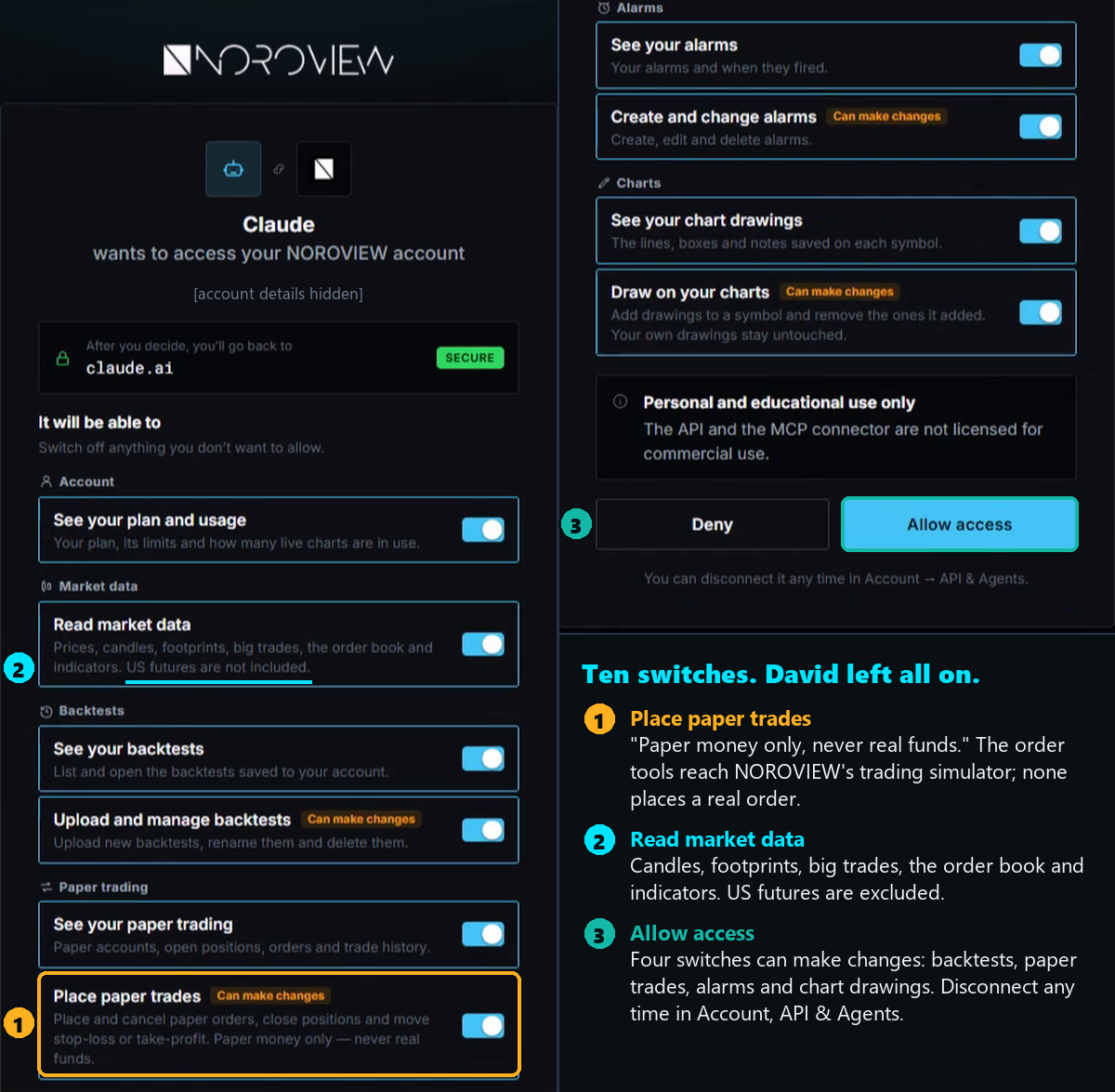
- Claude sends you to NOROVIEW to sign in, then to a consent screen with ten switches. Turn off anything you do not want to allow, then click Allow access.
- Back in Claude, the connector lists NOROVIEW's tools: 19 read-only and 9 that write or delete, each group with its own permission. In the recording both read Needs approval.
Claude Code users can skip the dialog: the panel gives a one-line claude mcp add command. Anthropic's help center says custom connectors work on every Claude plan, with Free limited to one. NOROVIEW's panel says ChatGPT and Cursor take the same address; we did not test them, and ChatGPT's plan limits are in the FAQ below.
What Claude can and cannot do once connected
Read access covers your plan, market data, backtests, paper accounts, alarms and chart drawings. Four switches can change things: uploading and deleting backtests, placing and cancelling paper orders, creating and deleting alarms, and drawing on charts. The connector can remove only the drawings it made itself.
"Paper money only, never real funds" holds. The connector's only order tools send orders to NOROVIEW's paper-trading simulator, whose accounts have no deposits or withdrawals, and no tool reaches a real exchange account. US futures data is never served through the API. NOROVIEW re-checks your plan on every request, and you can disconnect any time in Account → API & Agents. Leave the approval prompts on: an assistant that can delete your backtests should ask first.
The prompt, and the line worth copying
David's prompt asked Claude to "design and backtest a profitable trading strategy" on the Kraken ETH perpetual, one-hour, 1 September to 31 October 2026, with four NOROVIEW indicators and fees, on plain candles rather than footprints to keep Claude's context light, and to upload the winner with its weaknesses listed. Its last line is the one to copy: "If nothing turns out profitable after fees, tell me honestly instead of forcing it."
Two of the four names did not match NOROVIEW's. There is no "Smart Signal", so Claude used NORO Signal; and the Smart Candle Filter is computed in the browser, where no connector tool runs it, so Claude tested Smart Trend instead and said so. Then reread the first line. Ask for a profitable strategy on one period and you will be handed the best of whatever was tried on it.
Watching it work: an error it caught itself
The video's "about 20 trades in two months" and "181 events" come from a note Claude wrote mid-run: both signal indicators "only fire from October 7 onward". That was wrong. NOROVIEW returns at most 30 days of indicator history per query, newest first, so a two-month request had silently come back as October alone.
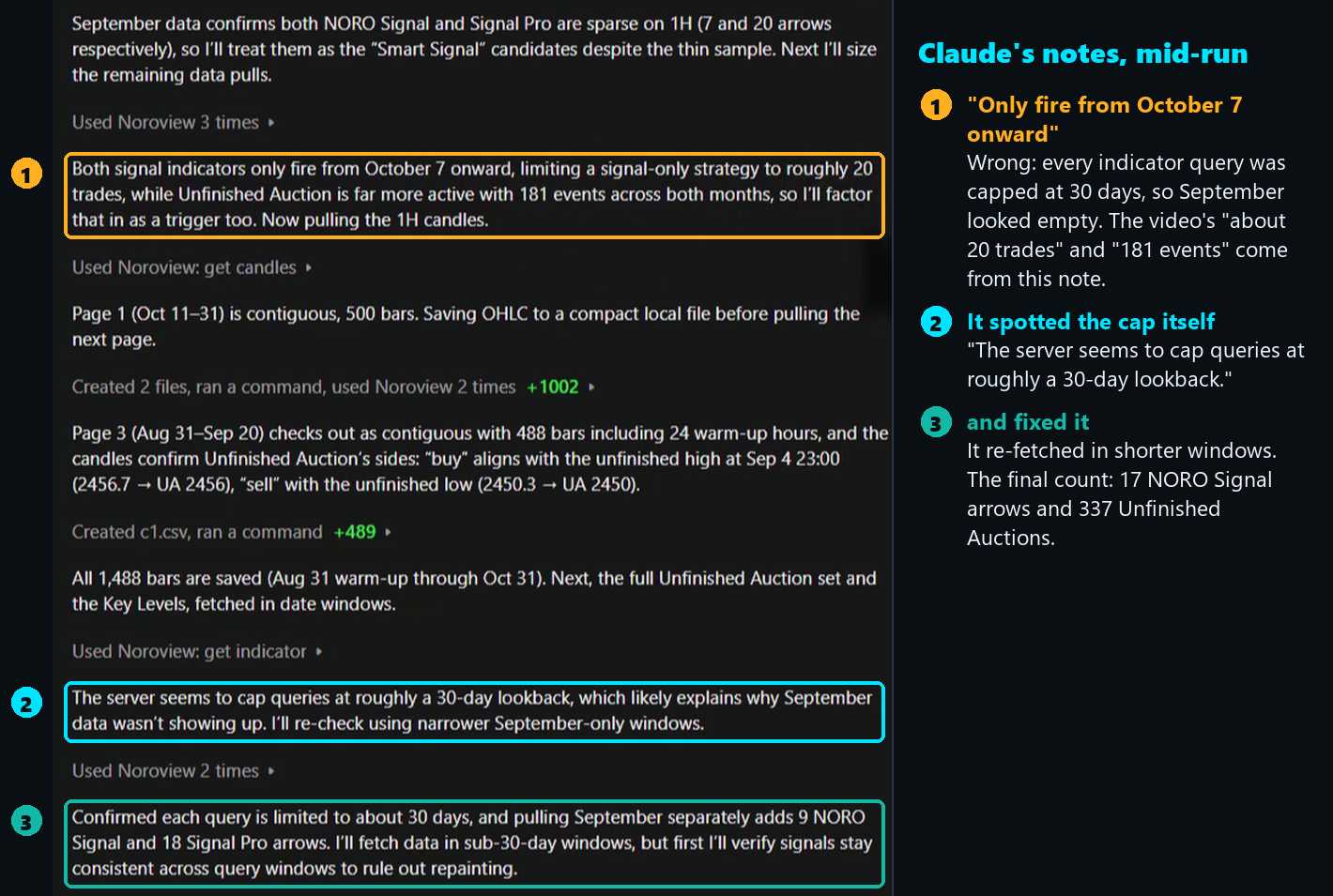
Claude spotted the cap a few steps later, re-fetched in shorter windows and found September. Credit where it is due - and a warning. This error announced itself because a whole month was empty. The next one might not. Check the counts an AI reports against the source.
The rules Claude uploaded, all six
David sums the strategy up as: enter on every NORO Signal arrow, stop at one and a half ATR, target the nearest open Unfinished Auction. The backtest's own description has six rules, and two are missing from that summary.
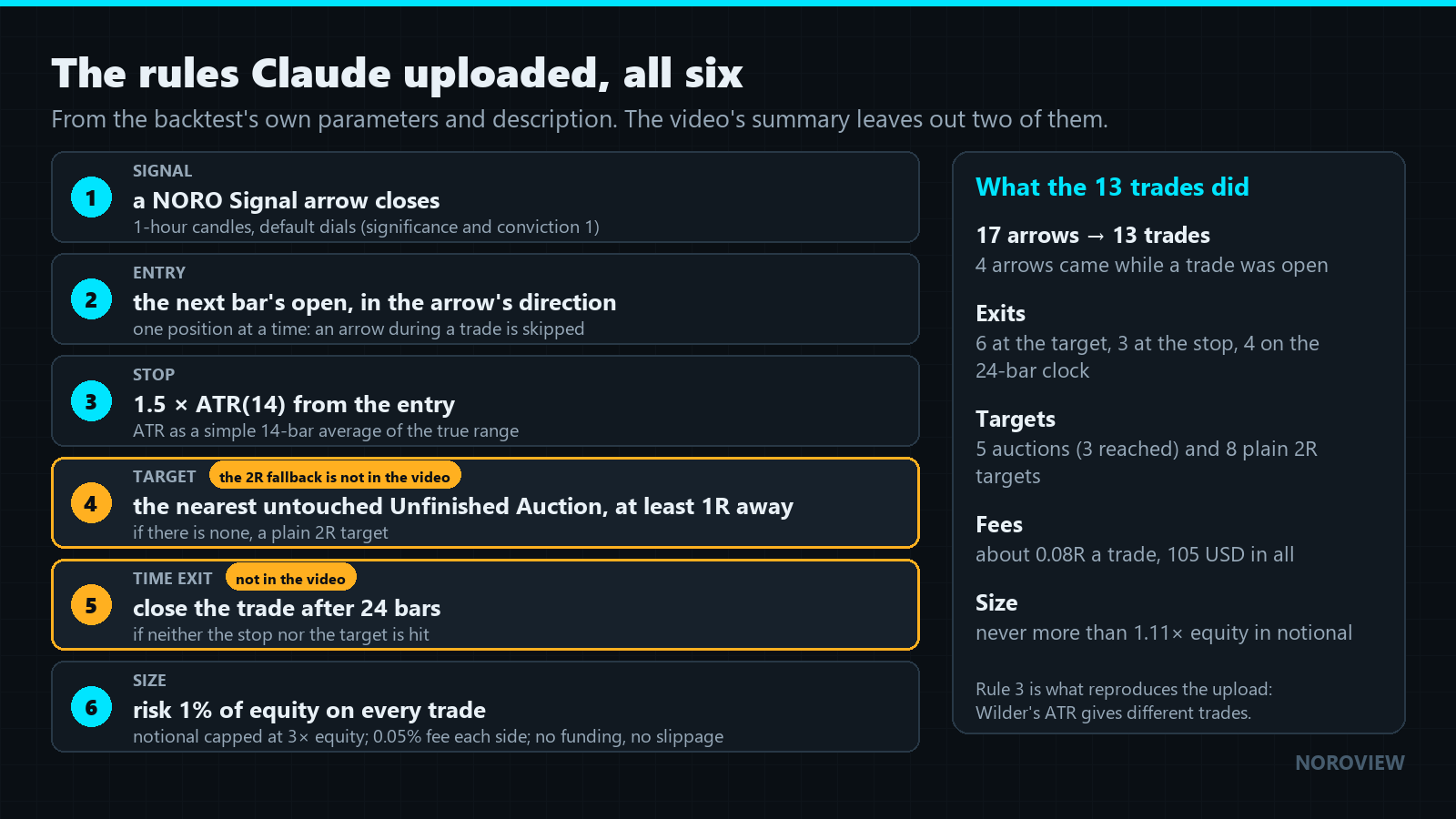
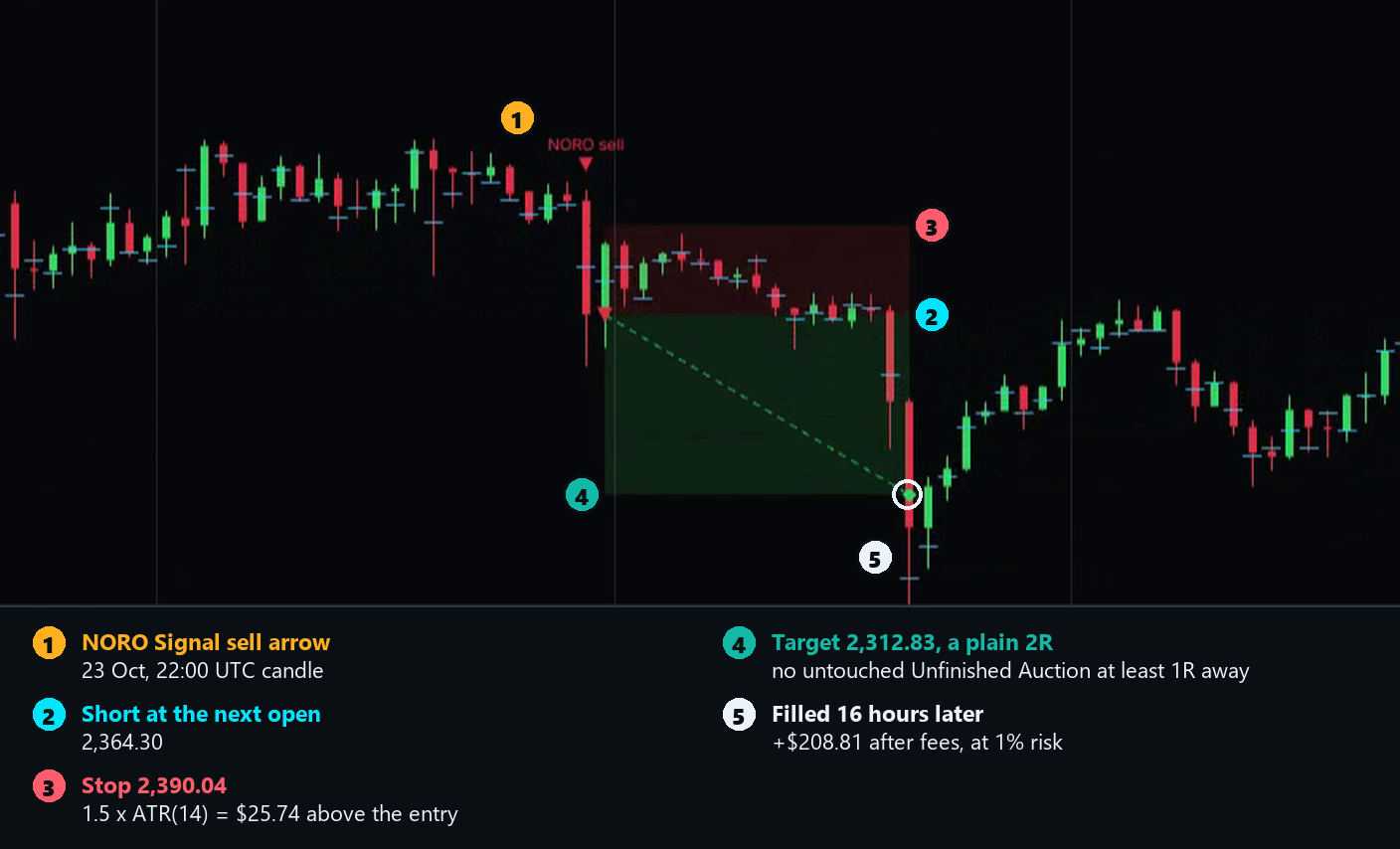
Both matter. Eight of the 13 trades found no untouched auction at least 1R away and used a plain 2R target, and four of the 13 ended on the 24-bar clock instead of at a stop or target. Rebuilding the trades also pinned down a detail no summary gives: ATR(14) here is a simple 14-bar average of the true range. Wilder's version, the usual default, gives different stops and a different result.
The results, and the arithmetic behind them
From $10,000 at 1% risk a trade, the uploaded backtest made $1,156.01, or +11.56%, over 13 trades: 9 wins and 4 losses.
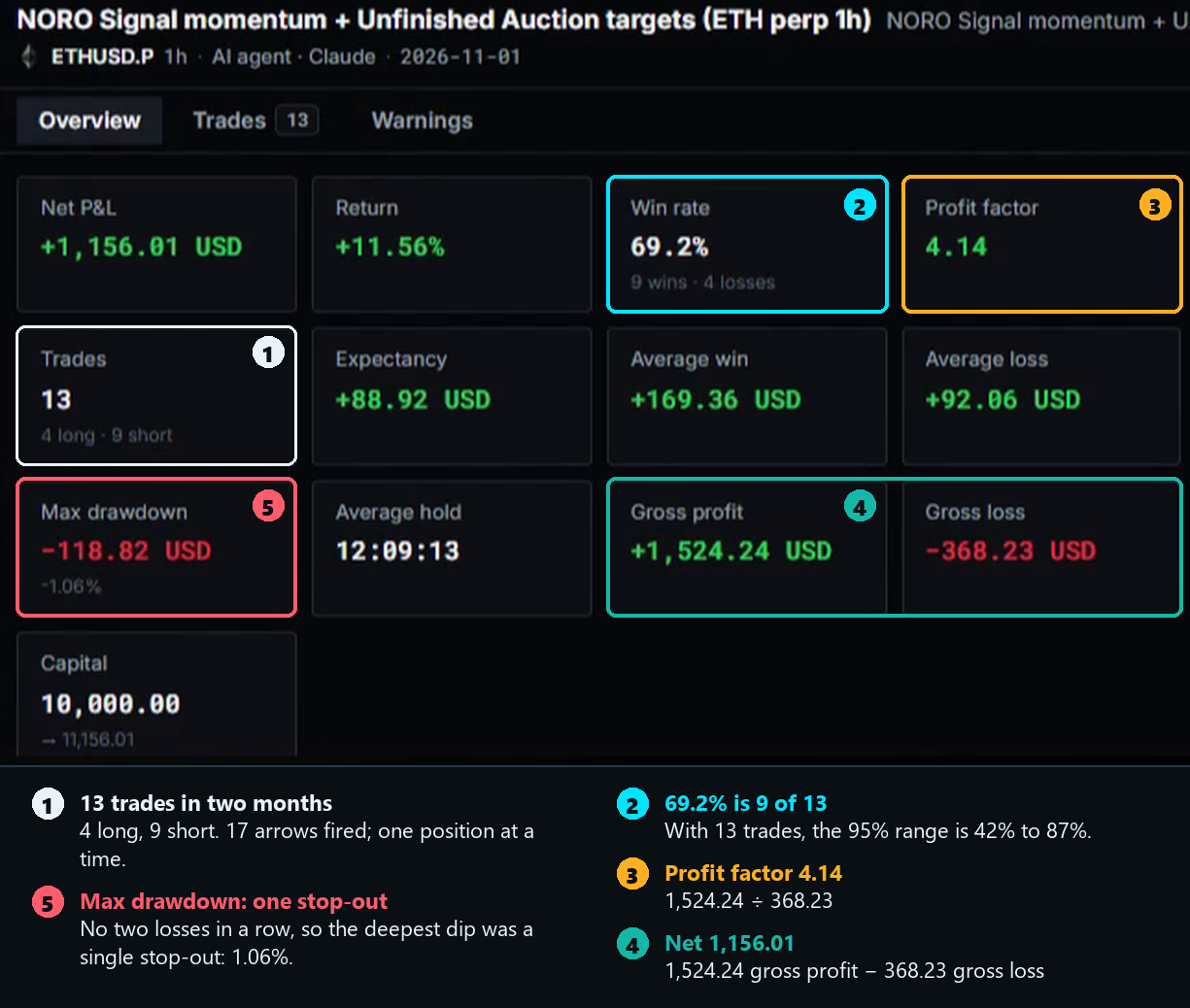
The panel's numbers fit together. Gross profit of $1,524.24 minus gross loss of $368.23 is the $1,156.01 net, and their ratio is the profit factor, 4.14. That is an average win of $169.36 and an average loss of $92.06 (the panel prints it as a green "+92.06"; it is the average losing trade). In risk units, wins averaged 1.61R and losses 0.83R, under 1R because one loser left on the clock at -0.16R. At that payoff the break-even win rate is 34%, so the 69% has room to fall. One trade did a lot of the work: the 14 September short that ran to the auction at 2389 made $429.81, 37% of the profit. Without it, the return is +7.26%.
The drawdown is the cleanest part of the record. The 13 results ran W L W W W W W L W L W W L: no two losses in a row, so the worst dip was a single stop-out. The -1.06% is trade 8, from a peak of $11,014.32; the -$118.82 beside it is the last trade, from a higher peak. Two different dips, each one loss.
Why 13 trades cannot carry it
Nine wins in 13 trades is 69.2%, but a sample that small fits a wide range of true win rates: the 95% interval (Wilson's method) runs from 42% to 87%. Its low end is still above the 34% break-even, which would be encouraging for a single test chosen in advance. This was the best of 288, and the interval does not know that.
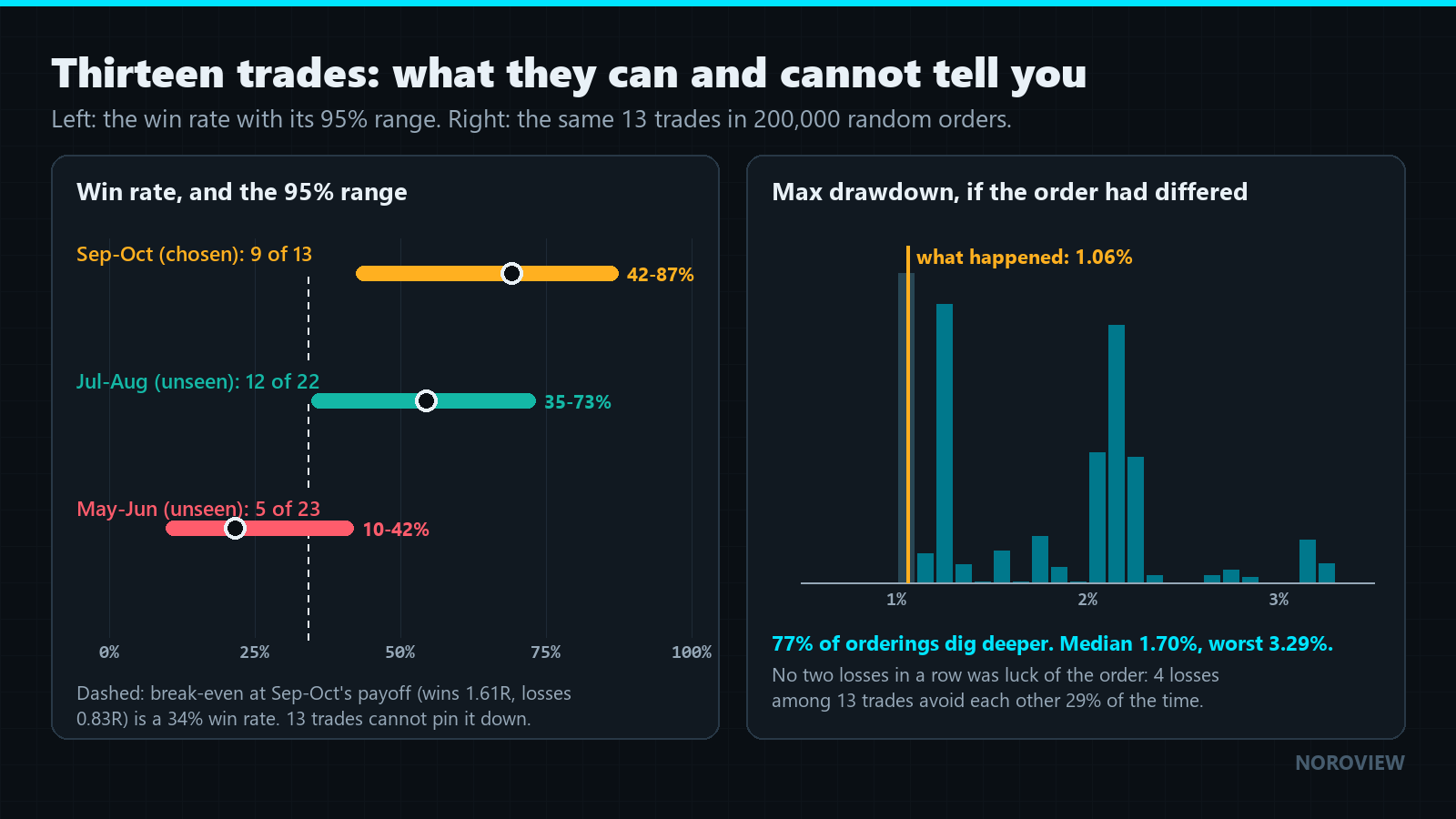
The drawdown is fragile in a different way. Shuffle the same 13 trades into 200,000 random orders and the maximum drawdown is deeper than 1.06% in 77% of them, with a median of 1.70% and a worst case of 3.29%; four losses land with no two adjacent only 29% of the time. And 13 trades cannot tell you at all how these rules behave in a rally, a crash or a range, after funding and slippage, or in any other two months.
Try this now
Audit an AI's backtest before you read its summary. Open the Backtests tab in NOROVIEW, open the Description and Parameters, then click three trades and check each entry, stop and target against the rules on the chart. If one does not match, trust nothing else in the report.
Build your own test
A free NOROVIEW account gives you the charts and real-time crypto data. The AI connection starts on Basic ($19 a month), and a strategy built on NORO Signal needs Pro ($39), which also stores 100 backtests and allows 300 API requests a minute. Check the plan before you write the prompt.
Create a free account -> · Compare plans ->
The best of 288: why the winner looks better than it is
Claude's report is candid about what it tried. Half the 288 variants traded with the arrows and half against them.
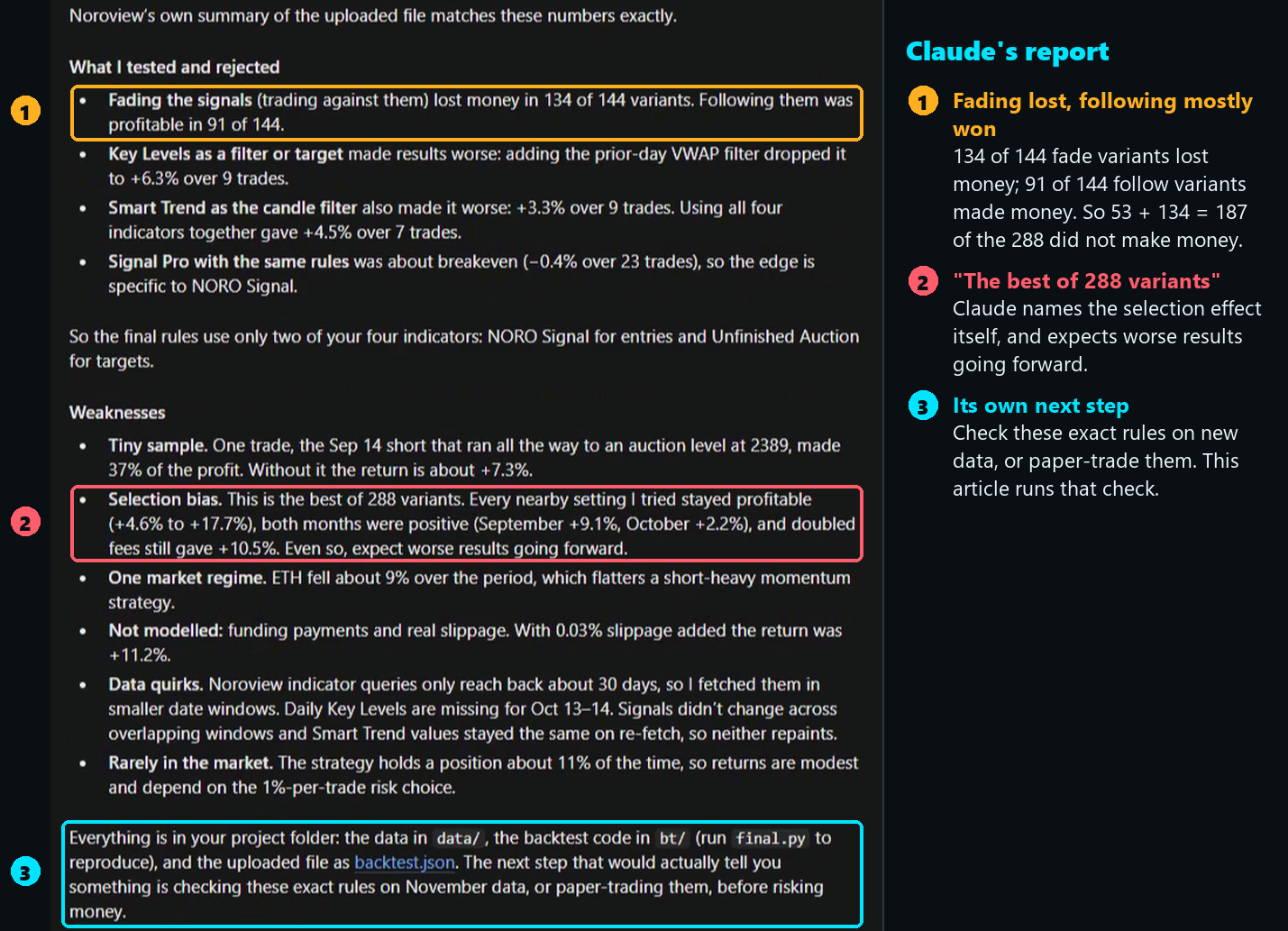
Fading the arrows lost money in 134 of 144 variants; following them made money in 91 of 144. So 53 + 134 = 187 of the 288 did not make money - the number in the lesson's Short, which is arithmetic on the report rather than a line in it. Filters made things worse - Key Levels cut the return to +6.3%, Smart Trend to +3.3% - and swapping in NORO Signal Pro as the entry roughly broke even.
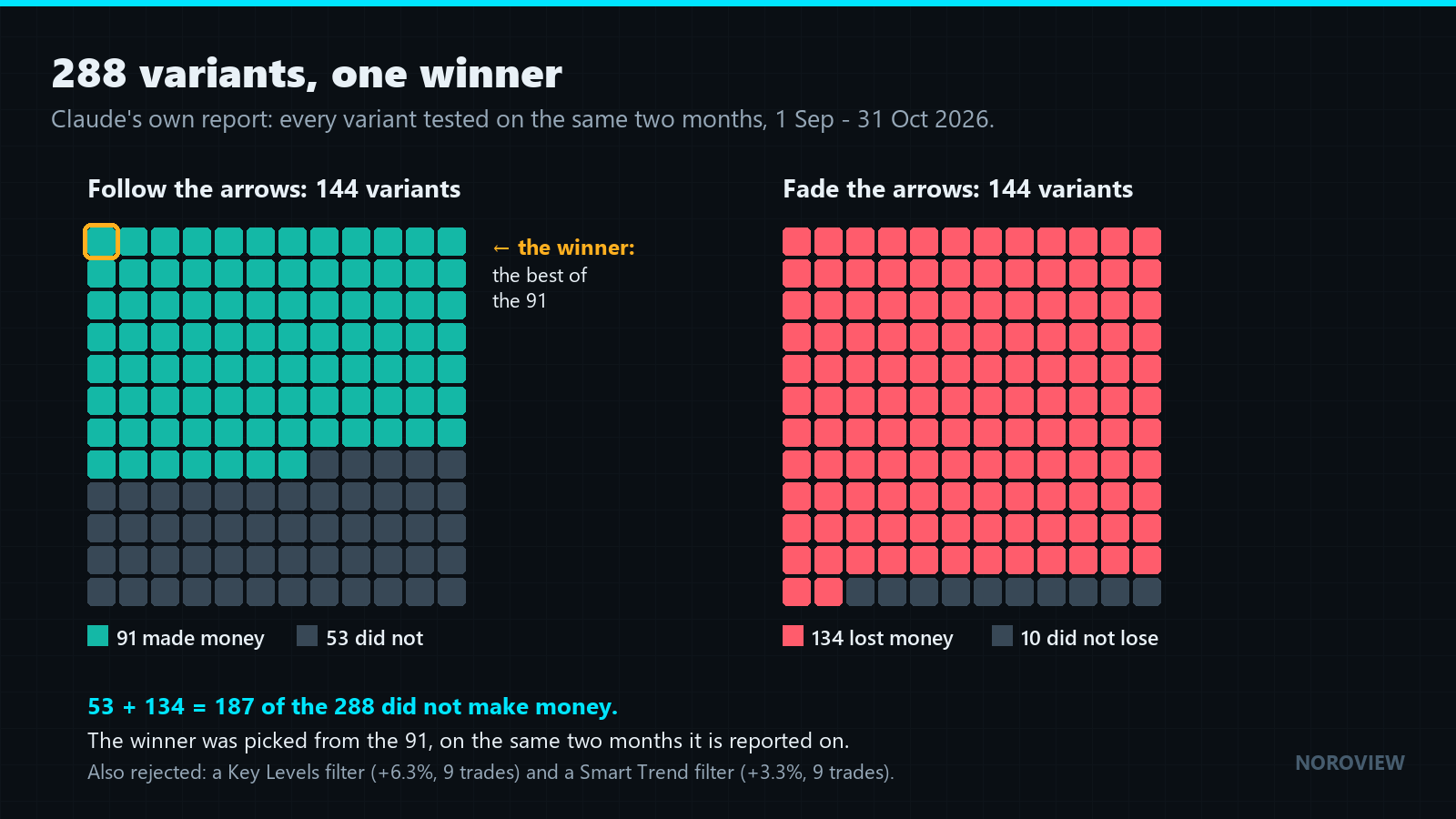
Read the 91 carefully. Nearly two-thirds of the follow variants making money says these two months paid momentum after the arrows: ETH fell 8.7%, and 9 of the 13 trades were shorts. That is a fact about September and October, not proof of the idea. And picking the best of many on one sample builds luck into the result by construction. Claude named it "selection bias" itself, and told David to "expect worse results going forward".
We ran Claude's rules on four months it never saw
That is testable, so we tested it. The rebuild above uses NOROVIEW's own data - arrows and auctions through the same connector, every deciding bar checked against NOROVIEW's candles. We ran its identical rules, nothing re-tuned, on the four months before: July to August, and May to June.
| Period | Result at 1% risk | ETH |
|---|---|---|
| Sep-Oct (chosen) | 13 trades, win 69%, PF 4.14, +11.56%, max DD 1.1% | -8.7% |
| Jul-Aug (unseen) | 22 trades, win 55%, PF 1.68, +6.45%, max DD 2.6% | +57.2% |
| May-Jun (unseen) | 23 trades, win 22%, PF 0.54, -8.41%, max DD 10.1% | -30.5% |
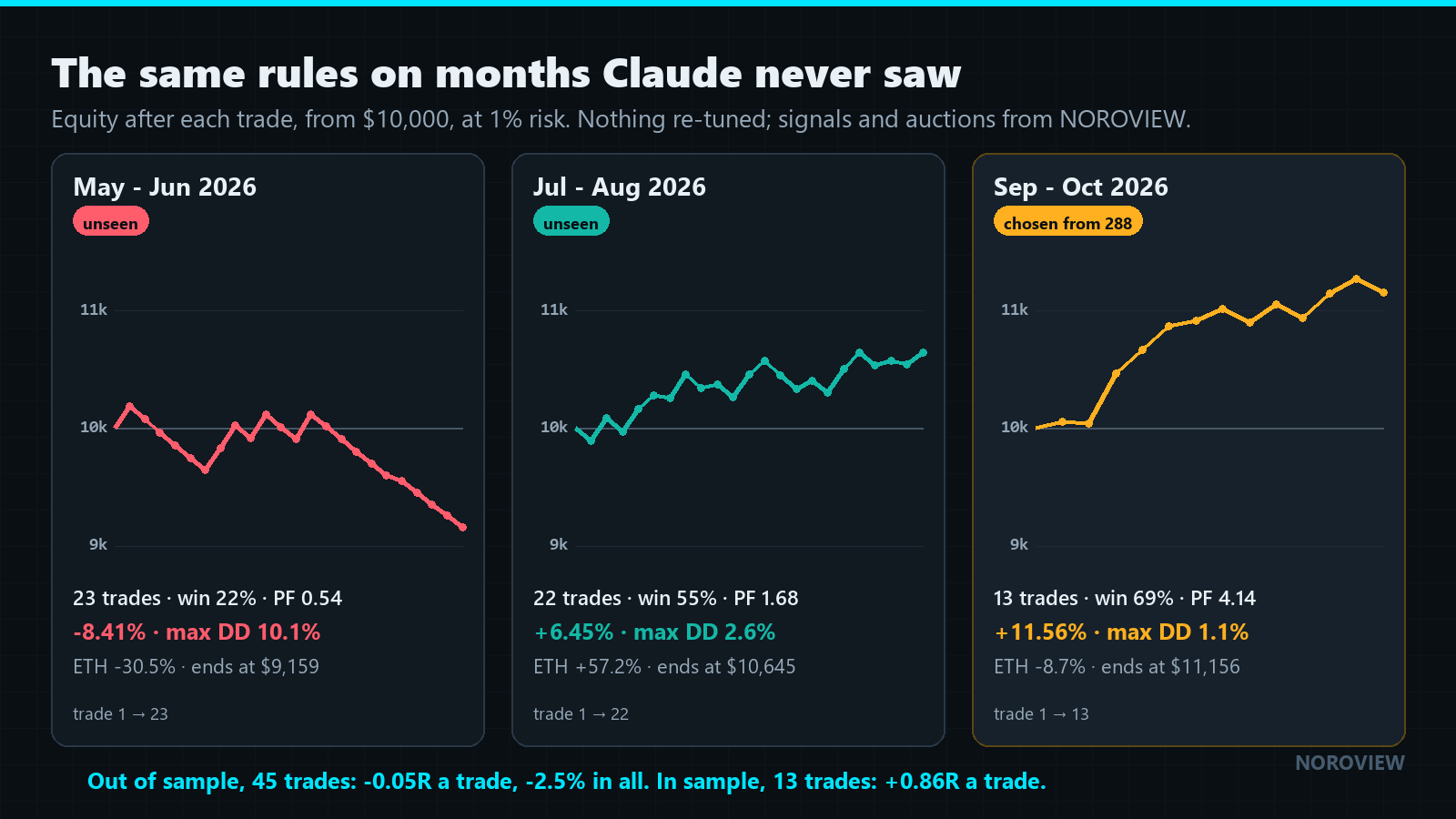
Over the 45 unseen trades the rules lost 0.05R a trade, -2.5% in all, against +0.86R a trade in the months they were chosen on. Before fees the unseen months were roughly breakeven, +0.02R a trade, and the fees took the rest. July to August held up in a 57% rally. May to June - a 30% fall, the kind of market Claude said flattered its short-heavy winner - lost 8.41%, with ten losses in a row. At 5% risk, the level the same rules were also uploaded at (+67% in sample), May to June would have lost 38% with a 43% drawdown.
Two details show how soft the decimals are. Count untouched auctions from mid-August instead of from 31 August, where Claude's data happened to start, and the in-sample result falls to +9.42%. One July trade turns from a loss into a win if its entry moves 30 cents. Four months and 45 trades are still a small test, and they cannot show the idea is worthless. They show the in-sample numbers did not carry over.
What a fair test looks like
The lesson chose and reported on the same two months. A fair test needs three things, decided before you look at a single result:
- Hold data back. Build and choose on one period, and leave the next one alone until the rules are final.
- Freeze the rules, then run them once on the held-out data. Re-tuning after a peek turns it back into in-sample data.
- Count the variants. The more you try, the better the best looks by chance, and 288 is a lot of chances. Researchers have formal corrections for this, such as the probability of backtest overfitting.
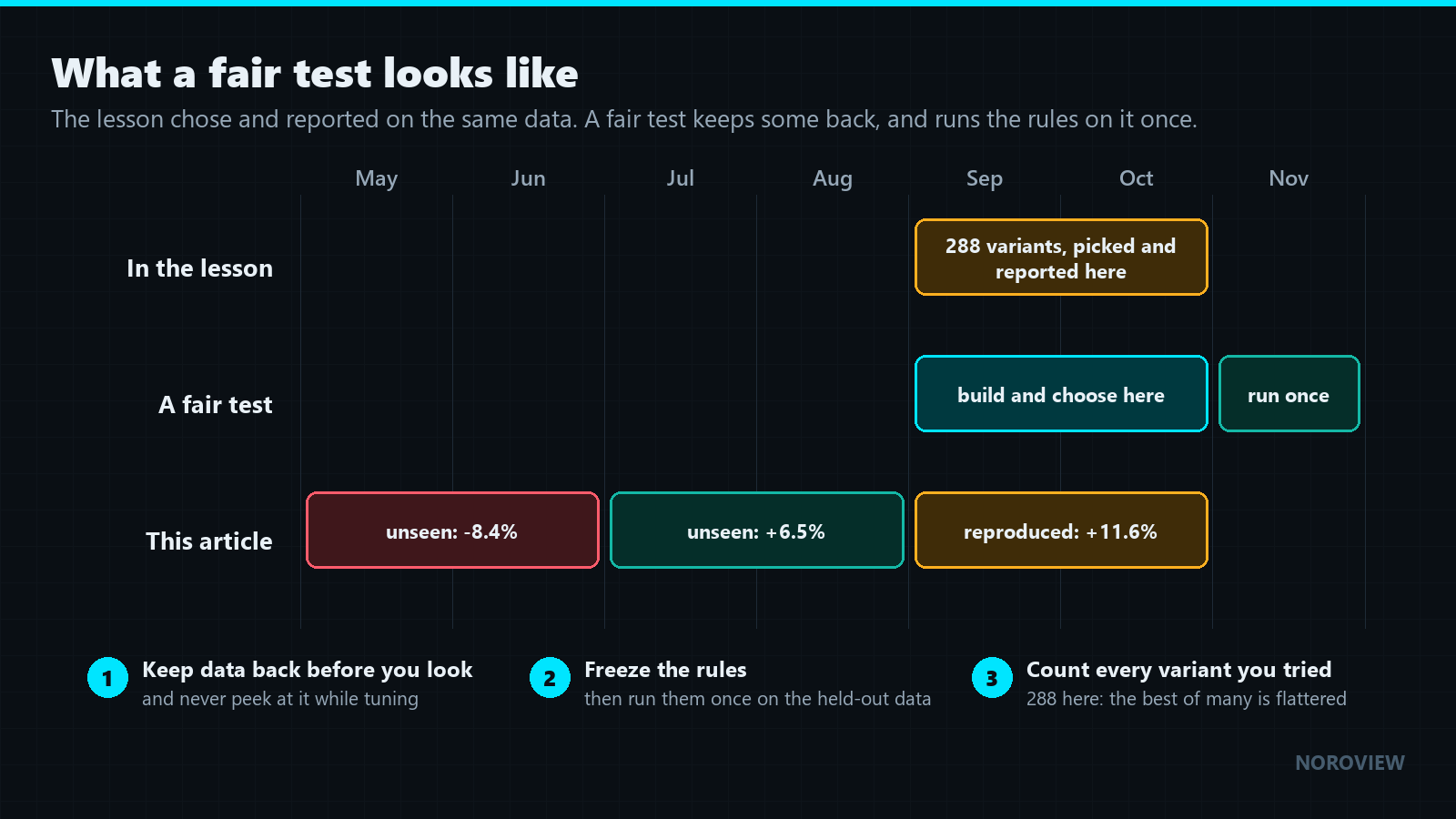
Claude's own suggested next step was the right one: run the exact rules on November, or paper-trade them. You can ask an AI to make the split for you; put it in the prompt, before it starts.
Perpetual futures: what the backtest leaves out
The market here is a perpetual future, and the backtest skips two of its costs. Funding: Kraken's documentation says it accrues continuously on perpetuals and settles every hour, and the backtest leaves it out entirely. And leverage: at 1% risk the positions never exceeded 1.7 times the account, but a perpetual lets you borrow far more, and high leverage puts the liquidation price close enough that a fast move can close you out before your stop is reached. The written course explains leverage and liquidation; read it before trading any of this live.
What this lesson does and does not show
- Claude ran a search, not a discovery. It tried 288 rule sets on two months and kept the best. That is a parameter search; it did not "find an edge".
- A backtest is hypothetical. No slippage, no funding, fills at exact prices, one exchange's data.
- AI output can be wrong. In this one run: a misread data window, two indicator names matched by guesswork, and a target rule whose result depends on where the data happened to start. Check the uploaded rules against the trades, one by one, as David starts to.
- Our test is small too. 45 trades over four months show the in-sample result did not carry over. They do not prove the rules can never work.
Claude is Anthropic's AI assistant; Anthropic has no part in NOROVIEW or this strategy. Nothing here promises a return.
The checklist
- Read the uploaded rules, not the chat summary.
- Check three trades by hand: entry bar, stop and target.
- Ask how many variants were tried, and discount the winner for it.
- Hold data back before you look, and run the frozen rules on it once.
- Read the sample: trade count, longest losing streak, and the biggest trade's share of the profit.
- Add what the backtest left out: funding and slippage.
- Paper-trade it, and size it to lose.
Your homework for lesson 7
- Connect Claude to a NOROVIEW account on a plan that allows it, and switch off the permissions you do not need.
- Ask for a strategy on a symbol you follow, and tell it to hold back the last two months.
- Open the uploaded backtest and check three trades by hand.
- Run the frozen rules on the held-back months and compare R per trade.
- Paper-trade whatever survives for a month before anything else.
The crash course, lesson by lesson
| Lesson | What it covers | Video |
|---|---|---|
| Lesson 1 | Average trade size, footprint basics, what a candle hides | Watch |
| Lesson 2 | Trend trading with order flow: spotting reversals early | Watch |
| Lesson 3 | A live trade: absorption and exhaustion at the turn | Watch |
| Lesson 4 | Volume profile on gold, read through PAXG | Watch |
| Lesson 5 | Volume profile shapes (P, b, D) and trend reversals | Watch |
| Lesson 6 | A live gold trade, entry to exit, on XAUUSD | Watch |
| Lesson 7 (you are here) | Connecting an AI assistant to live order flow data | Watch |
| Lesson 8 | Monthly VWAP and the key levels price reacts to | Watch |
| Lesson 9 | Entry confirmation with absorption and exhaustion | Watch |
The whole course on one page: the crash course overview, with the four claims these articles tested in one table.
The 16-lesson Order Flow Trading Course covers this ground from scratch - including level 1 vs level 2 data, footprint charts, cumulative volume delta, absorption and exhaustion and risk management.
Frequently asked questions
Can AI backtest a trading strategy?
It can write and run one. Connected to market data, an assistant like Claude can pull candles and indicators, code the rules, include fees and report the statistics; here its result matched an independent rebuild trade for trade. It cannot make the result reliable: the best of many variants on one period is flattered, so hold data back and test the frozen rules on it.
Can Claude backtest a trading strategy with NOROVIEW?
Yes, through NOROVIEW's MCP connector, added as a custom connector in Claude Desktop or on claude.ai, or with one command in Claude Code. It needs a NOROVIEW plan with API access, Basic or above, and strategies built on smart indicators such as NORO Signal need Pro. Claude runs the backtest in its own code and can upload the result to your account.
Can ChatGPT do the same?
NOROVIEW's panel says the connector works with ChatGPT and Cursor; we have not tested either. OpenAI's help center lists custom MCP servers with write actions on its Business, Enterprise and Edu plans and read-only access on Pro, so uploading a backtest from ChatGPT may need one of those plans.
What is out-of-sample testing?
Running a strategy on data that played no part in building or choosing it. In-sample results show how well rules fit the past they were tuned on; out-of-sample results are the nearest a backtest gets to the future. Here, 13 in-sample trades made +0.86R each, and 45 out-of-sample trades lost 0.05R each.
Can the AI trade real money through NOROVIEW?
No. The connector's order tools reach NOROVIEW's paper-trading simulator only - "paper money only, never real funds", as the consent screen says. With your permission it can place, close and cancel paper orders.
Sources
Everything on screen in this article comes from the lesson video, recorded on a live NOROVIEW chart. External claims are linked below.
- Lesson 7 of the NOROVIEW Order Flow Crash Course, the video this article is built from - watch on YouTube
- Anthropic help center, custom connectors using remote MCP - support.claude.com
- Model Context Protocol, introduction - modelcontextprotocol.io
- OpenAI help center, connecting custom MCP servers in ChatGPT - help.openai.com
- Kraken, futures fee schedule - kraken.com
- Kraken Support, multi-collateral perpetual contract specifications and funding - support.kraken.com
- Bailey, Borwein, López de Prado and Zhu, The Probability of Backtest Overfitting - ssrn.com
Test an AI's strategy the fair way
Connect Claude to NOROVIEW, ask for a strategy with the last two months held back, and run the frozen rules on them before you believe a number. Lesson 8 turns to monthly VWAP and the key levels price reacts to.
Create a free account -> · Compare plans ->
David is NOROVIEW's official tutor. He teaches order flow the way it is actually read - on a live chart, one idea at a time, in plain English. The whole course is free, there is no signal group, and he will never tell you a setup is a sure thing. The crash course on YouTube · About NOROVIEW
⚠ DISCLAIMER - EDUCATIONAL CONTENT ONLY
This article is for educational and informational purposes only. It is not financial, investment, or trading advice, and nothing in it is a recommendation to buy, sell, or hold any asset. Trading cryptocurrencies and leveraged derivatives is high risk and can result in the loss of some or all of your capital. Only risk money you can afford to lose. Any levels, indicators, signals or numbers shown are illustrative and are not a promise or prediction of future performance. Charts are shown on a demo or paper-trading account and do not represent real trades or returns. Always do your own research. You alone are responsible for your decisions.
Keep reading
Related posts
Order Flow Trading Tutorial: 9 Free Video Lessons, Written Up and Tested
David's free Order Flow Crash Course in one place: nine video lessons on live charts, seven written up in full, and the four claims we tested on months of market data, with every result in one table.
9. Does Order Flow Work? We Tested David's Footprint Entry Checklist
David's entry checklist - big volume at a level, sellers absorbed, then exhausted, then aggressive buyers - on one Ethereum trade he calls 1:4. We checked every number, worked out the R the video does not, then tested the checklist at every VWAP touch against random levels. Lesson 9, the finale of the free Order Flow Crash Course.
8. Does VWAP Work? We Tested 1,848 VWAP Levels Against Random Ones
David shows ETH returning to August's monthly VWAP two months later, where its downtrend ended. We rebuilt that level to the cent, then tested 1,848 monthly, weekly and daily VWAPs on ETH and BTC against random levels, with the rules fixed first. Lesson 8 of the free Order Flow Crash Course.
5. P-Shaped and b-Shaped Volume Profiles: Reading Shapes Inside a Trend
A P-shaped leg in an uptrend is healthy, a b-shaped one is a warning - and the close against the value area matters more. But on a leg anchored at its swing points, those two rules measure the same thing. Lesson 5 of the free Order Flow Crash Course, on PAXG and Ethereum.
4. Does XAUUSD Have Volume? Gold's Volume Profile, Read Through PAXG
On a gold CFD the volume bars count quote changes, not trades. This lesson reads gold's volume profile through PAXG, a gold-backed token with real trade-by-trade data - then tests that proxy across three venues and ten weeks, because the video only asserts it.
2. How to Confirm a Trend Reversal: Verified Highs, Verified Lows and Delta
Most reversal advice is a list of indicators. This is a rule: a low is verified only once a new high clears the previous one, and the trend is over the moment price closes through that low. Then order flow tells you whether the move behind it was real. Lesson 2 of the free Order Flow Crash Course.
Discussion (0)
Want to join the discussion? Comments live inside the platform.
Open NOROVIEW